
 01↗
Low-maintenance haircuts for fine, straight hair
Compare blunt bobs, collarbone cuts and longer outlines for fine straight hair, with realistic styling trade-offs and clear salon questions.
A clear outline. A surprisingly specific set of decisions.
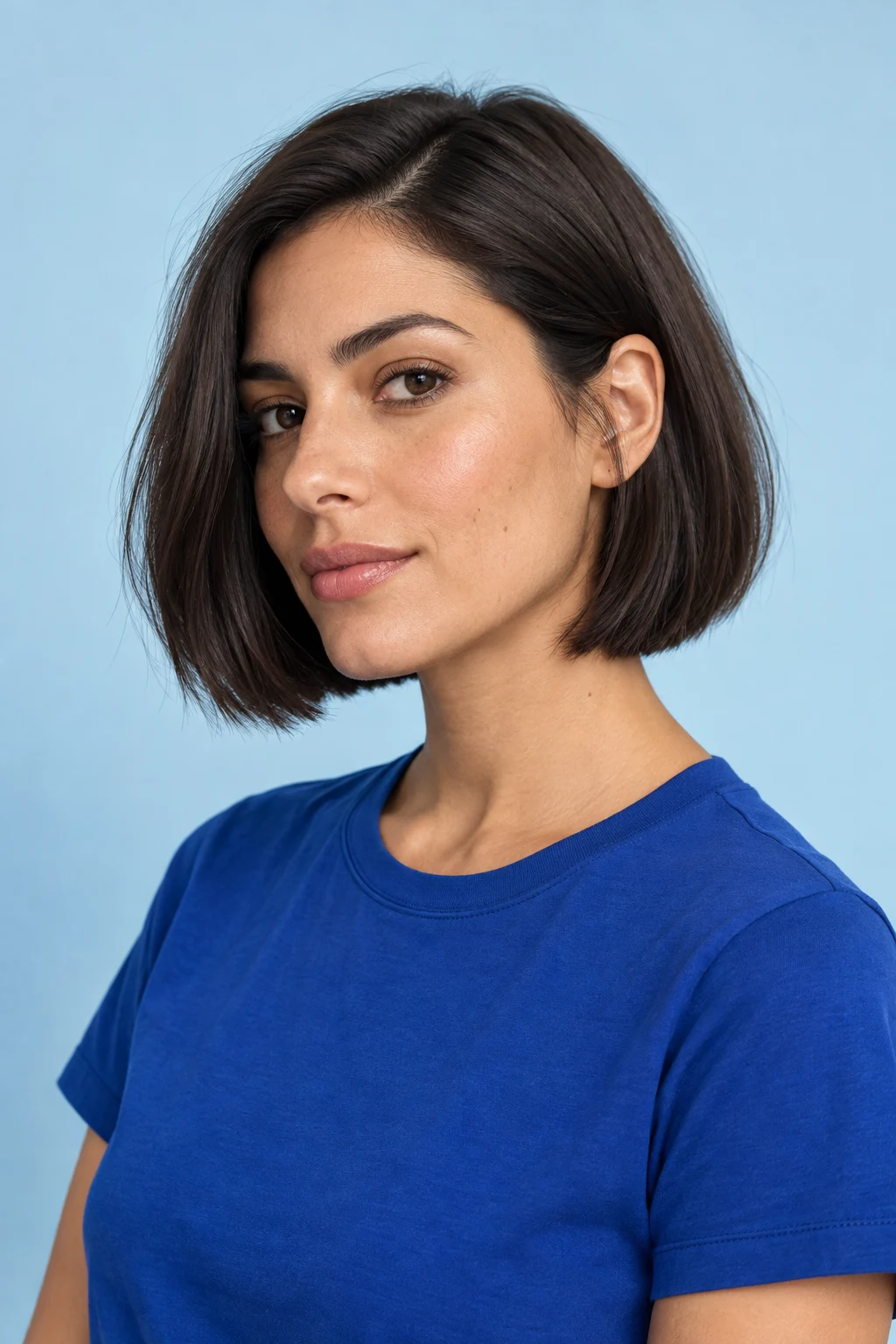
A blunt bob places the visual weight at the perimeter. From the front, you notice a relatively continuous line instead of a stack of short layers. That makes the finish feel deliberate even when the surface is slightly imperfect. Blunt describes the outline; it does not require every strand to be identical in length or every hair type to be pressed straight.
The useful length is a landmark on your own body. A jaw-length reference on somebody with a long neck may look quite different when copied as the same number of inches. Point to the place you want the dry edge to sit, then check it from the side. Your shoulders, natural part and tuck all influence how compact the finished outline appears.
If individual strands are fine, keeping a substantial perimeter may help the ends look more continuous. That does not automatically rule out a little internal shaping. Ask what any proposed layering would change about the bottom line before agreeing to it. Fine hair with high density can feel heavy; fine hair with lower density may need a more conservative approach to removing weight.
Look at your hair in its ordinary finish rather than only immediately after a salon blowout. If you routinely tuck one side, bring a reference with that tuck. If a cowlick lifts the front, ask to see the dry fall before deciding the shortest section. The aim is a line you like under the conditions you actually wear it.
Try a faux bob by loosely folding your lengths under, understanding that pins cannot reproduce the weight of a real haircut. Photograph the outline with your usual glasses and neckline. You are testing where you enjoy seeing an edge, not proving that your hair will behave exactly like the folded version.
In Hair Muse, compare a blunt bob and a slightly longer bob using the same source photo and color direction. Watch the jaw, side width and visible neck. Treat unexpected changes to the face or hairline as generation artifacts. Take the preferred outline and a written length boundary to a stylist for a feasibility check.
I want a continuous bob outline around this dry landmark. Please preserve enough front length for an ear tuck and show me how the edge falls at my natural part before shortening further.
Give the silhouette a little practical context.
01↗Compare blunt bobs, collarbone cuts and longer outlines for fine straight hair, with realistic styling trade-offs and clear salon questions.
02↗Prioritize the front, part and outline when a bob needs a quick reset. Treat five minutes as a planning limit rather than a guaranteed result.